Open data
This page lists the public files generated by the Mapping Tournai pipeline. The project does not publish Mapillary photos or raw image downloads. The current public data is metadata-derived coverage information: where street-level imagery appears to exist, how fresh it is, and whether it is 360-degree imagery or front-facing imagery.
The published files are generated from PostGIS and refreshed as the analysis is rerun. /maps/data/current/ always points to the latest website generation, while /maps/data/snapshots/ keeps dated versions.
Current catalogue
| Dataset | Format | Link | What it contains |
|---|---|---|---|
| Data manifest | JSON | /maps/data/manifest.json | Current snapshot identifier and previous map generations. |
| Global summary | JSON | /data/global-summary.json | Road length, coverage counts, image count, and global covered/missing totals. |
| Area summary | JSON | /data/analysis-units-summary.json | One row per analysis area: Tournai centre and the 29 villages. |
| Freshness summary | JSON | /data/freshness-summary.json | Fresh, stale, outdated, and no-image road lengths. |
| Global coverage | GeoJSON | /maps/data/current/global-coverage.geojson | Municipality-wide road coverage from the broad point-density model. |
| Global freshness | GeoJSON | /maps/data/current/global-freshness.geojson | Same global road segments, styled by image freshness. |
| Tournai street coverage | GeoJSON | /maps/data/current/tournai-street-coverage.geojson | Full street-level working layer for the Tournai analysis unit, including no-coverage segments. |
| Tournai coverage quality | GeoJSON | /maps/data/current/tournai-coverage-quality.geojson | Public quality layer used by the web maps and 3D map. No-image streets are omitted to keep the visual layer focused. |
| 3D buildings | GeoJSON | /maps/data/current/tournai-center-buildings-3d.geojson | OpenStreetMap building footprints and building:part geometries with explicit, level-derived, or default estimated heights. |
| Green spaces | GeoJSON | /maps/data/current/tournai-center-green-spaces.geojson | OpenStreetMap parks, cemeteries, woods, and related green-space polygons used by the 3D map. |
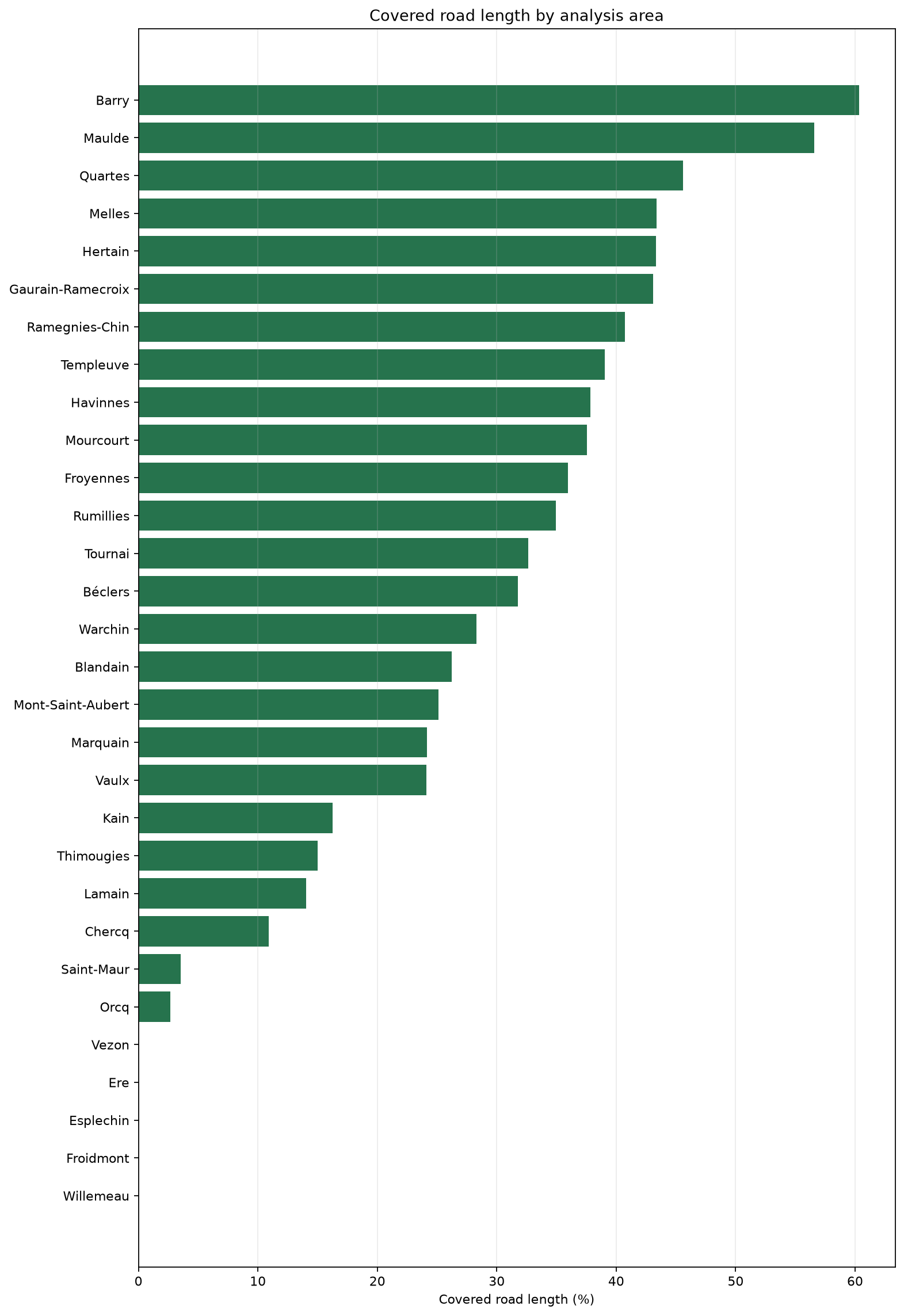
| Covered percentage chart | PNG | /charts/covered-percentage-by-unit.png | Generated comparison chart for the analysis areas. |
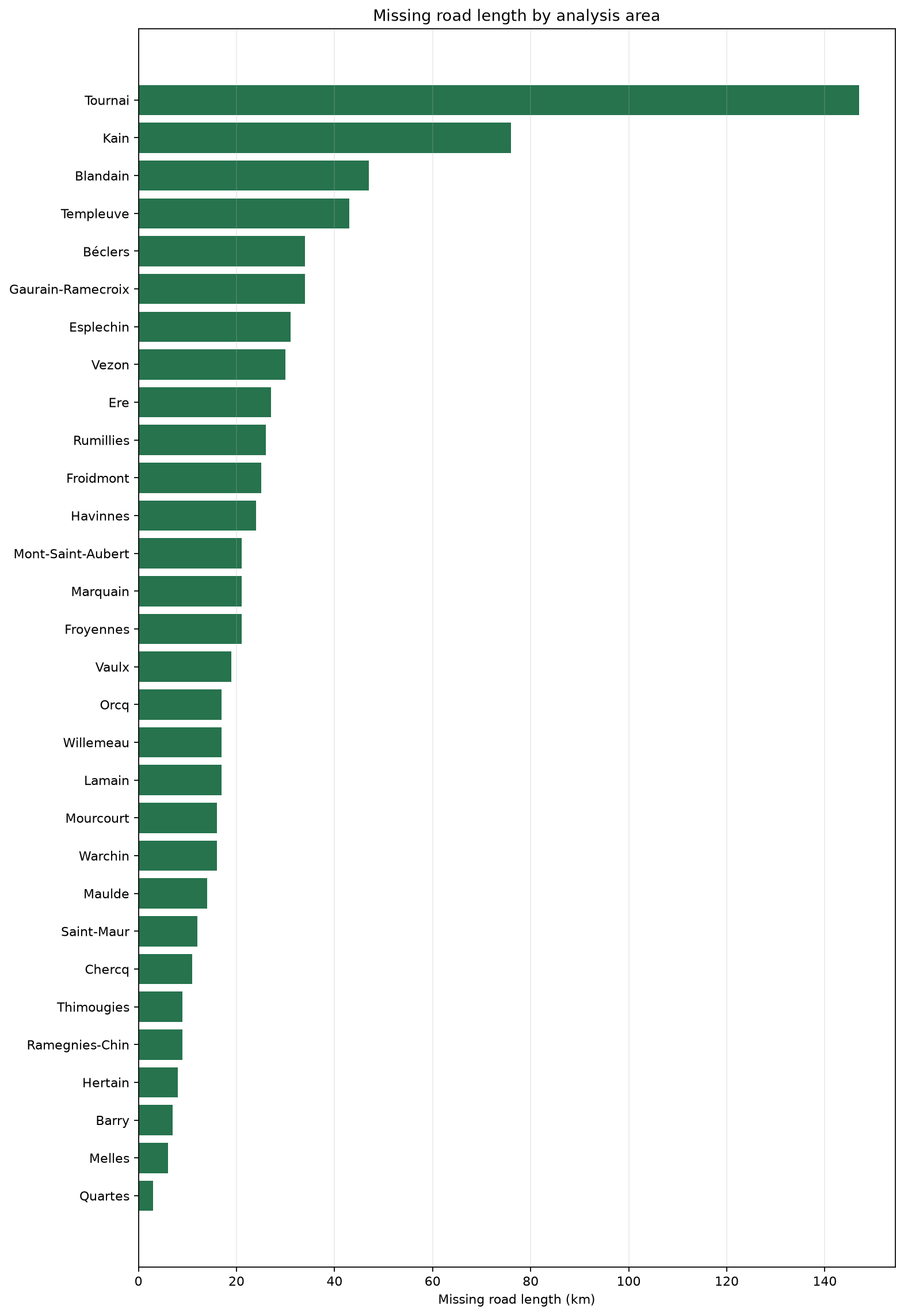
| Missing length chart | PNG | /charts/missing-length-by-unit.png | Generated comparison chart showing where field work can close large gaps. |
Area-level GeoJSON
Each analysis area also has a generated coverage file under /maps/data/current/areas/.
Examples:
/maps/data/current/areas/tournai-coverage.geojson/maps/data/current/areas/gaurain-ramecroix-coverage.geojson/maps/data/current/areas/barry-coverage.geojson/maps/data/current/areas/vezon-coverage.geojson
Limits
These datasets are planning aids, not authoritative road inventories. Coverage is inferred from Mapillary metadata, OpenStreetMap road geometry, and configurable spatial thresholds. Pending Mapillary uploads may be visible on mapillary.com before they appear in the API used by this site.
The coverage files describe where imagery exists or appears useful. They do not publish the photos themselves, contributors’ original uploads, or a claim that every mapped object has been surveyed.
Future open-data ideas
The current public data mostly answers “where have we captured imagery?”. The next useful open-data layer should add value beyond that. Candidate directions:
- a history of coverage improvements by refresh date,
- a reviewed list of streets still requiring fresh 360-degree imagery,
- a public queue of OpenStreetMap checks discovered from field captures,
- building-height enrichment status for the 3D map,
- reusable scripts and documented thresholds for running the same analysis in another city.
For now, the project will keep the open-data catalogue conservative and evidence-backed: generated files are published when their provenance and limitations are clear.